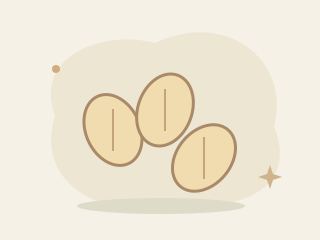
Ginkgo nut
ToxicGinkgo seeds are toxic to dogs. Ginkgotoxin blocks activation of vitamin B6, collapsing GABA synthesis in the brain and causing seizures. Street-tree windfall is the usual exposure.
This food guide has not been reviewed by a veterinarian. It summarises general information from sources and should not be used to decide whether a food is suitable for an individual dog or to assess an emergency.
Check before feeding
Do not offer as a treat
There is no recommended treat portion for this hazardous item. If swallowed, contact a vet with the amount, time and product details. Do not induce vomiting yourself.
Signs and health concerns
This list includes both observable signs and conditions identified through examination or testing. It cannot establish the cause or whether an exposure is safe.
- Vomiting
- Irritability
- Agitation
- Tremors
- Poor coordination or balance
- Loss of consciousness
- Seizures
More about this food
Ginkgo seeds are toxic to dogs, and the mechanism is specific. The seed contains ginkgotoxin, or 4'-O-methylpyridoxine, which inhibits pyridoxal kinase, the enzyme that converts vitamin B6 into its active form. With pyridoxal-5-phosphate depleted, glutamate decarboxylase cannot keep up, GABA synthesis falls, and the brain loses its main inhibitory brake. Seizures follow. Human poisonings, especially in children, include documented convulsions and deaths, and the ASPCA Animal Poison Control Center lists ginkgo seed as toxic to pets.
No canine mg/kg threshold has been published. In human cases relatively few seeds have affected children, and the effect accumulates when seeds are eaten repeatedly over a short period, so there is no number of nuts you can reason your way into calling safe. In reported human cases signs begin 1 to 12 hours after ingestion: vomiting, irritability, agitation, tremors, ataxia, reduced consciousness, seizures and convulsions.
The fleshy outer seed coat is a separate problem. It contains ginkgolic acids, which cause contact dermatitis and GI irritation, and it is the source of the notorious smell.
In the US this is a sidewalk exposure, not a kitchen one. Ginkgo biloba is planted as a street tree in cities across the country, and female trees drop fruit onto pavement and lawns every fall. Do not confuse this with the ginkgo leaf extract sold as a human supplement; the toxic part here is the seed, and human supplements should never be given to a dog without veterinary direction either. If your dog eats ginkgo seeds, call your veterinarian immediately even with no symptoms, or the ASPCA Animal Poison Control Center at (888) 426-4435, staffed 24/7 for a fee. Do not induce vomiting at home. Pyridoxal phosphate resolves signs in human cases, but that is a treatment a veterinarian gives and monitors, not a supplement to hand out at home.
Frequently asked questions
- My dog picked up ginkgo fruit on a fall walk.
- Call your veterinarian now, even if your dog seems fine. No safe number of seeds exists for dogs, and signs can take 1 to 12 hours to appear. Report the time and rough quantity, and watch for tremors, agitation, staggering, and seizures. Do not induce vomiting at home.
- Are cooked or roasted ginkgo nuts safer?
- No. Cooking does not remove ginkgotoxin, so roasted ginkgo nuts served as a side dish or in restaurant food carry the same risk. Repeated small amounts over a short period also accumulate, which makes a habit of sharing them worse than a single incident.
- Is ginkgo biloba supplement the same thing?
- It is a different part of the plant. The toxicity described here is in the seed, not the leaf extract sold for people. That does not make a human supplement appropriate for a dog, though, so do not give any ginkgo product without your veterinarian's direction.